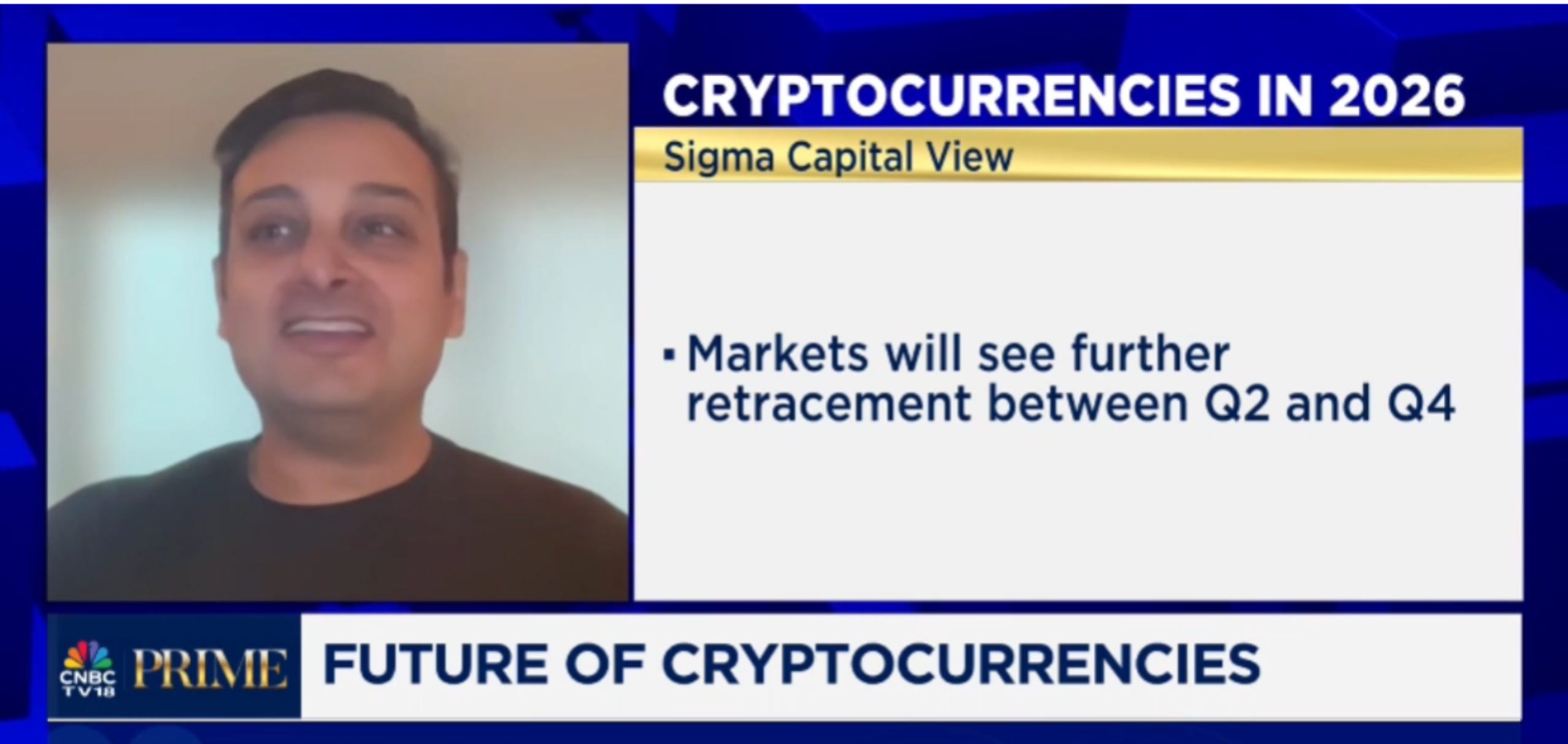
By December 2025, every major crypto fund had published their 2026 outlook.
While we respect the analysis, when 76% of institutions plan identical allocations and everyone’s positioning for the same institutional adoption narrative, crowded trades rarely deliver alpha.
76% of institutions planning tokenized asset allocations
Theme 6: Corporate Treasury Adoption Accelerates
151 public companies now hold $95B in Bitcoin
17.867% of BTC supply in institutional hands
Global expansion beyond U.S.
Sigma’s Take:
These aren’t wrong; they’re table stakes. Here’s what the reports miss...”
The real question isn’t where the industry is headed, but when milestones hit, where value settles, and whether adoption meets projections.
Traditional forecasting models presume orderly adoption, successful execution, and distributed gains. History suggests otherwise: economic models fail at scale, infrastructure deployment outpaces user readiness, and returns concentrate unexpectedly.
Our differentiated view isn’t about dismissing consensus themes, it’s about scrutinizing which players win early, which lag behind, and what’s already reflected in today’s valuations.
The adoption reality check:
Every digital asset requires real users: not capital inflows alone. Major Layer 1s continue missing revenue benchmarks despite protocol improvements.
Infrastructure is ahead of demand: we’re building the rails before anyone’s boarding the train.
When institutional playbooks converge, outperformance demands different positioning. Here’s where consensus thinking falls short.
A. Bitcoin: Reassessing the Institutional Consensus
Consensus View: Institutional participation via ETFs creates structural support; strong appreciation expected from steady institutional accumulation.
Where We Align with Consensus:
We agree that institutional participation is accelerating and represents a structural shift in Bitcoin’s market composition:
ETF inflows are real and material – Institutional access channels are now established
Corporate treasury adoption is expanding – 151 public companies holding $95B+ validates the strategic asset thesis
Regulatory clarity is improving – The institutional framework is solidifying
These developments are structurally significant and mark a genuine evolution in Bitcoin’s maturity as an asset class.
Where We Diverge from Consensus:
However, consensus overlooks a critical counter pressure that could limit upside:
While institutions build positions, a substantial portion of Bitcoin remains in the hands of early retail holders sitting on life-changing gains. The data tells a concerning story:
Over 1M BTC sold in recent corrections (largest since 2019)– significant distribution from long-term holders.
Strong profit booking pressure continues – retail participants actively de-risking at these levels
This isn’t about questioning institutional adoption, it’s about recognizing that two-way flow dynamics matter. The old guard taking profits can act as a brake on the rising cycle, regardless of how much fresh capital institutions deploy.
B. Ethereum: The L2 Value Capture Problem
Consensus View: ETH benefits from staking ETFs, RWA issuance on mainnet, and “ultrasound money” deflationary mechanics.
Where We Align with Consensus:
Ethereum remains the default settlement layer for institutions.
ETF approvals, custody infrastructure, and developer dominance (4,000+ active devs) create genuine moats.
RWAs and stablecoins anchor on Ethereum first, BlackRock’s BUIDL, USDC, and tokenized treasuries validate this.
Institutional gravity is real and compounding.
Where We Diverge from Consensus:
Sigma Capital diverges on value capture, not relevance. Consensus assumes network usage automatically accrues to ETH.
Reality: L2s (Arbitrum, Optimism, Base) process 10-15x more transactions than mainnet. Staking ETFs create demand but don’t drive usage.
Having said that, Ethereum remains the institutional settlement layer with regulatory and custody advantages that are hard to replicate.
C. Prediction Market:
Consensus View: Institutions expect prediction markets to hit mainstream in 2026 with $28B+ trading volume signaling consolidation. Sports betting platforms (Kalshi, Polymarket) lead adoption through DraftKings/FanDuel partnerships.
Where We Align with Consensus: Prediction markets demonstrate real institutional demand beyond speculation:
High trading volume confirms market validation – $28B in 10 months represents serious capital allocation, not retail experimentation
Consolidation phase inevitable – As platforms mature and seek scale, M&A activity will accelerate with billion-dollar acquisitions expected
Sports as entry point provides regulatory clarity – Consumer betting establishes legal frameworks and proven user acquisition models
We’ll watch institutional hedging volume vs consumer betting volume, this mix determines acquisition premiums.
Where We Diverge from Consensus: Consensus emphasizes consumer betting; we prioritize institutional information markets (significantly larger opportunity)
Macro events, regulatory outcomes, and corporate actions enable actual hedging and risk management for institutions, not just speculation
Traditional finance acquirers (CME, Bloomberg, data providers) will drive consolidation, not gaming companies
D. AI Agents: The 2027 Story Everyone’s Trading in 2026
Consensus View:AI agents become the primary users of blockchains in 2026, driving massive transaction volume and creating new primitives.
Where We Align with Consensus:
We agree with the long-term structural thesis connecting AI and crypto:
AI agents will eventually require native, programmable payment rails – Traditional banking systems aren’t built for autonomous, micro-transaction-heavy workflows.
Crypto is the most logical candidate for autonomous, global settlement – Permissionless, programmable money fits AI’s operational requirements.
On-chain infrastructure will play a role in AI coordination – Decentralized networks can facilitate agent-to-agent interactions at scale.
The directional case is sound. AI and crypto convergence is a matter of when, not if.
Where We Diverge from Consensus:
Our divergence centers on timing and market readiness. Our Core Concern is Narratives priced 18–24 months early tend to underperform once reality catches up.
The market is pricing AI-agent activity as a 2026 revenue driver. We believe the infrastructure, regulatory clarity, and enterprise adoption required for this thesis to play out won’t materialize until next year.
E. RWAs: Bullish on the Theme, Skeptical on Timing
Consensus View: RWAs will double in 2026, with tokenized T-bills, private credit, and equities moving from pilots to production.
Where We Align with Consensus:
We’re structurally bullish on RWAs as a category:
Tokenized T-bills and private credit are real, durable use cases – These aren’t speculative experiments; they solve genuine institutional needs
RWAs are the most credible bridge between TradFi and DeFi – They offer familiar risk profiles with blockchain efficiency
Regulatory clarity is improving materially – DTCC approval and evolving frameworks provide institutional comfort
Infrastructure is maturing – The technical rails for issuance, custody, and settlement are operational
RWA tokenization is happening. The infrastructure is coming online, and real capital is flowing into these products.
Where We Diverge from Consensus:
Our divergence isn’t about whether RWAs scale, it’s about how they distribute globally. Distribution, not tokenization, is the real moat.
RWA isn’t just about tokenizing a real-world asset or replicating TradFi products on-chain, it’s in building distribution networks that make these products accessible globally without friction. That’s the RWA thesis worth betting on.
F. Stablecoins: The $500B Story (With a Critical Twist) :
Consensus View:Stablecoins can hit $500B+ , driven by institutional adoption and potential G7-pegged consortium launches.
Where We Align with Consensus:
Stablecoins are a generational opportunity. The sector is experiencing genuine product-market fit beyond speculation:
Real utility emergence: Payment settlements, cross-border transfers, and treasury management are moving on-chain. The $33 trillion in transaction volume (2025) vs. $308B market cap shows genuine velocity and usage.
Market cap growth trajectory: Moving from $308B to $500B+ by late 2026 represents ~60% growth, which is conservative given historical patterns during bull cycles and increasing adoption curves.
Where We Diverge from Consensus:
The “hit $500B in 2026” framing misses the real story:
Winner-takes-most market structure: Network effects and standard-setting matter more than growth projections. Speed and first-mover advantage trump governance perfection, once institutions standardize on one stablecoin, switching costs become prohibitive.
Two underpriced risks:
CBDCs are competitive, not complementary - central banks are building to replace private stablecoins once they scale, not coexist with them
Algorithmic designs dismissed too quickly—newer mechanisms could capture share from centralized players vulnerable to regulatory pressure.
Sigma Capital’s Partner View:
“The path is infrastructure adoption, not overnight replacement. The most enduring opportunities are foundational: settlement layers, data infrastructure, yield mechanisms systems that compound value beyond speculative cycles.”
— Vineet Budki, Managing Partner, Sigma Capital
Conclusion
“Conviction Over Consensus”
In a market where everyone’s reading the same reports, alpha comes from having the conviction to bet differently.
At Sigma Capital, we don’t chase consensus. We chase structural opportunities the market hasn’t priced yet.
See you on-chain.”
-Sigma Capital
Important Disclosures
This publication is provided for informational and educational purposes only and does not constitute investment advice, a recommendation, or an offer or solicitation to buy or sell any securities or investment products. Nothing herein should be relied upon in making any investment decision.
No Investment Advice: This content does not contain all material information necessary for making an investment decision. Sigma Capital does not provide investment advisory services through this publication and accepts no fiduciary duty to readers.
No Guarantees or Warranties: While information herein is obtained from sources believed to be reliable, Sigma Capital makes no representation or warranty, express or implied, regarding the accuracy, completeness, fairness, or reasonableness of any information, opinions, or forward-looking statements contained herein.
Risk of Loss: All investments carry inherent risk, including the risk of total loss of capital. There is no guarantee that any investment strategy, instrument, or asset class discussed will be profitable.
Forward-Looking Statements: Any predictions, forecasts, or forward-looking statements are based on current assumptions and subjective judgments as of the publication date. Such statements should not be relied upon as they are subject to change without notice. Sigma Capital undertakes no obligation to update this content.
Subjectivity and Limitations: Market commentary, analyses, and opinions reflect the author’s views as of the date of publication and may be based on incomplete information or subjective assumptions.
Not Professional Advice: This publication is not intended to provide, and should not be relied upon for, accounting, legal, tax, or professional investment advice. Readers should consult qualified professionals regarding their specific circumstances.
Past Performance: Past performance is not indicative of future results.